Search Results for:

Image of Author
Adam Yates
2 minute read

Certified & accredited Google Ads Partner

I am really excited to announce that FullSphere is now officially a certified Google Ads partner. This partnership reflects our dedication to achieving results for businesses and our commitment to delivering high-performing campaigns.

What does being a Google Partner mean?

Being a Google Partner means that we have met the rigorous standards set by Google in terms of knowledge, performance, and customer care. Here is an overview of what this partnership offers:

1. Certified expertise

Our team has undergone extensive training and passed certification exams to demonstrate mastery in Google Ads. This includes areas like Search Advertising, display advertising, and analytics. With this expertise, we handle everything from basic pay-per-click (PPC) campaigns to advanced multi-channel strategies.

2. Access to exclusive insights

As a Google Partner, Fullsphere benefits from advanced tools, industry research, and insights that help us stay ahead of Digital Marketing trends. These resources allow us to refine campaigns, improve targeting and ensure that our clients reap the rewards of the latest advancements in advertising.

3. Early access to new features

FullSphere is among the first to learn about new Google Ads features and updates. This early access gives our clients a competitive edge, allowing them to adopt innovative strategies and technologies before the roll out.

4. Continuous support

Our Google Partner status provides us with a direct line to dedicated Google support teams. This ensures fast troubleshooting and seamless implementation of solutions, backed by Google’s expertise. It means quicker resolutions for any campaign challenges and smoother execution of complex strategies.


Summary

You can view our official accreditation directly on Google’s Partner directory here.


As a trusted Google Ads partner, we are here to help you grow your business with data-driven strategies and expert insights. Whether you’re looking to boost traffic, increase conversions, or enhance your brand presence, we have the tools and expertise to make it happen.


Ready to elevate your digital marketing?

Contact us today and discover how we can drive your business forward with Paid Ads.

Image of Author
Joe Britch
3 minute read

Less is more

The principle of simplicity

“How much text should we use?” is a question clients ask us daily.

While detail can be powerful in a whitepaper or legal document, digital marketing doesn’t need the same approach. Websites, slogans, and pitch decks should be simple and clear. That’s what keeps their audience interested.

Simple text performs even better when supported by thoughtful graphic design. Working together, they can explain complicated ideas or share detailed information in a way that keeps the reader wanting more. That’s at the heart of simplicity: sharing only what people need to understand an idea.

As a business owner or entrepreneur, you’re passionate about what you do. So it’s natural to want to share everything you know – all the features, benefits and vision you’ve spent so long creating.

However, in our experience, this can be overwhelming for a new reader. While they process this information overload, your key messages may be missed.

The answer? Keep messaging simple. Focus on what’s truly important to that one specific reader.

As the old saying goes, it’s quality over quantity.

Working examples

Copywriting

Research shows that 80% of people read headlines, but only 20% read the rest of the copy. Hook your audience with short and snappy headlines.

Hefty paragraphs or sentences over 20 words tend to lose the reader’s attention, especially online. Some experts in the industry recommend keeping paragraphs to just a couple of sentences. By trimming the word count, you’ll find you say just enough to provoke questions and encourage contact.

Presentations

When it comes to presentations, less is more. We live in a fast-paced world where instant gratification is the norm. Even Microsoft celebrates the 10-20-30 rule: ten slides that take twenty minutes to present, using a 30-point type.

While you’ll want to adapt to your audience, think clean visuals, minimal text, and a sharp focus on the core message. This helps your audience stay engaged and absorb the information.

Websites

On average, users spend only 52 seconds on a webpage – you’ve got less than a minute to share your message.

Messaging and information on the website can be light. Say just enough about your main message to encourage action.

Slogans

Simple language doesn’t mean boring. Simple language increases the chances of recall of your message and has more impact. There’s science behind this: clarity and creativity are two essential components of a successful slogan.

Think about Nike’s slogan, “Just Do It.” These are three impactful, memorable, and simple words. The slogan is inspirational and far from boring.

Simple messaging forces you to be creative and helps you get to the point. This shows you’re trustworthy, reliable, and know what you’re talking about – just what every business wants.

Conclusion

Understand the power of simplicity and use it to your advantage. Tease the audience with enough information to make them feel engaged, excited, and hungry to know more.

Image of Author
Joe Britch
8 minute read

A comprehensive guide to structuring an investment deck

Securing an investment is often a crucial step for startups and growing companies. An investment deck serves as initial foundations, acting as a visual narrative that outlines your business’s potential and value proposition.

In this guide, we delve deep into the key elements of structuring an effective investment deck, there is no official recommended page structure however you can use this as a guide to ensure your presentation captures the attention of potential investors.

Front cover

The front cover page of any presentation provides an excellent opportunity to portray your business. Choose an impactful image, showcase your logo and brand to give a flavour of what’s to come. An ideal front cover will encompass the brand, have a clear title and invite the reader to engage and read further.

Company overview

One good way to start your investment deck is by providing a concise yet compelling overview of your company. Introduce your company’s mission, vision, and core values, highlight any general information about your mission, vision or brand ethos as a whole. This section sets the stage for investors, offering a snapshot of what your business is all about.

Problem statement

Investors are interested in solutions to real problems. Clearly define a problem your company is addressing. Discuss the pain points in the market and emphasise why solving this problem is crucial. This section helps investors understand the relevance and necessity of your product or service.

Solution

Following the problem statement, present your innovative solution. Outline how your product or service effectively addresses the identified problem. Use visuals, such as infographics or product demos, to illustrate the unique features and benefits of your solution. Clearly articulate how your offering stands out in the market.

Product

Dive into the details of your product or service. Highlight its key features, functionalities, and the value it brings to users. Use visuals, prototypes, or product demonstrations to make your offering tangible. Address any intellectual property (IP) or proprietary technology that gives your product a competitive edge.

Why now?

Address the timing of your venture. Explain why this is the opportune moment for your business to thrive. Highlight any market trends, technological advancements, or shifts in consumer behaviour that make your solution timely and relevant. Investors need to see the sense of urgency and relevance in your business model.

Market size

You can address the market opportunity by presenting a comprehensive analysis of your target market. Providing data on the total addressable market (TAM), serviceable addressable market (SAM), and your expected market share will help investors gauge the scalability and growth potential of your business. Visually speaking, maps and infographics for this section can engage viewers.

Competition

Acknowledge and analyse your competitors. Identify both direct and indirect competitors and assess their strengths and weaknesses. A good way of doing this is with a comparison slide, comparing the differences between your offering and your competitors. Clearly articulate your unique selling propositions (USPs) that set your business apart, demonstrating a thorough understanding of the competitive landscape will enhance your credibility in the eyes of investors.

Business model

Clearly define how your company plans to generate revenue. Outline your pricing strategy, sales channels, and distribution methods. Provide insights into your customer acquisition and retention strategies. A transparent and well-thought-out business model will instil confidence in investors and will highlight your revenue-generating capabilities.

Team

Everyone likes to see a face to a business. Introduce the key players driving your company’s success – your team. Highlight their expertise, relevant experience, and key accomplishments. Emphasise the complementary skills and synergy within the team. Investors invest not just in the idea but also in the team’s ability to execute the business plan.

Financials

Present a detailed financial projection that outlines your revenue, expenses, and profitability over the next few years. Include key financial metrics such as gross margin, net profit margin, and return on investment (ROI). Be realistic in your projections, providing a solid foundation for investors to assess the financial viability of your business.

Contact

Close your investment deck by providing clear contact information. Make it easy for potential investors to reach out and express their interest. Include email addresses, phone numbers, and any other relevant contact details. Additionally, express your eagerness to engage in further discussions and provide additional information as needed.

Conclusion

Crafting effective content for an investment deck requires a strategic blend of storytelling, data, and visuals.

By following this recommended page structure – from introducing your company to showcasing your team and financial projections – you create a comprehensive narrative that captivates potential investors.

Remember, each section serves a unique purpose in building confidence and understanding, ultimately increasing the likelihood of securing the investment your business needs to thrive.


Looking for professional assistance in creating your investment deck? Our team of expert investment deck designers can assist with designing a deck which captivates potential investors and boost your chances of securing funding. Please contact us for more information.

Image of Author
Joe Britch
6 minute read

The power of visual storytelling in Brand Marketing

A big part of modern logo advertising is visual storytelling, which has a lot of power to change how people think about a product and get them involved. In this virtual age, where interest spans are fleeting and opposition is fierce, groups are an increasing number of turning to the artwork of layout to face out amidst the noise. This piece goes into great detail about how layout has a big impact on logo advertising strategies. It stresses how important visual storytelling is for creating compelling stories that people can relate to.

The significance of Design in Brand Marketing

Design serves because of the visible language through which manufacturers speak with their goal audience. From trademarks to internet site layouts, each layout detail performs a vital position in shaping emblem identification and notion. A well-crafted layout now no longer most effective captivates interest however additionally conveys the essence of an emblem’s values, character, and offerings. It helps firms build out a wonderful identity that resonates with consumers and works as a powerful differentiating tool in a congested market.

The influence of visual storytelling

The art of telling stories is at the heart of effective brand advertising. By using things that can be seen to tell stories, companies can make people feel things, remember things, and make deep ties with their audience. Visual storytelling works across language barriers, letting brands send well-known themes that appeal to a wide range of people. Manufacturers can tell the story of their logo in a way that engages and inspires customers, building lasting relationships with them through engaging images, videos, and portraits.

The role of design elements

Design factors along with trademarks, colours, typography, and imagery play a pivotal position in shaping emblem notion and using patron engagement. A well designed brand serves as the cornerstone of emblem identification, immediately recognisable and imbued with meaning. Colours evoke precise feelings and associations, influencing patron perceptions on an unconscious level. Typography units the tone for emblem messaging, conveying character and style. Imagery and portraits in addition beautify the storytelling experience, bringing emblem narratives to existence in brilliant detail.

Case studies

Coca-Cola: Happiness, joy, and community are all associated with the famous pink and white Coca-Cola brand. Coca-Cola has created an iconic symbol that can be recognised across cultures by using consistent branding across many interactions.

Apple: From product layout to packaging, Apple exemplifies the strength of minimalist but impactful layout. Its smooth aesthetics and intuitive consumer interfaces have helped Apple domesticate a committed worldwide following.

Nike: Nike’s swoosh brand and formidable typography encompass the emblem’s ethos of athleticism, empowerment, and innovation. Through visually compelling advertising campaigns, Nike has set up itself as an image of concept and excellence.

Metronet Internet Plans: Metronet’s strategic use of layout factors in its advertising collateral has performed a vital position in positioning the emblem as a company of reliable, high-velocity net services. By leveraging captivating portraits and cohesive branding, Metronet correctly communicates its cost proposition to consumers.

Conclusion

In an increasing number of visible-centric worlds, layout has emerged as a robust pressure in emblem advertising. By harnessing the electricity of visible storytelling, manufacturers can create immersive reports that captivate audiences and foster emblem loyalty. From emblems to shadeation schemes, each layout detail contributes to shaping emblem identification and perception. By analysing successful branding campaigns and incorporating layout quality practices, organisations can increase their advertising techniques and leave a long-lasting impact on consumers.

Image of Author
Adam Yates
5 minute read

Digital Marketing channels to consider for growth

Achieving success with any campaign is reliant on adopting the appropriate marketing approach. Each marketing channel provides an opportunity to engage with a specific demographic. Depending on the industry, service or product, certain channels may perform better than others. As with any marketing campaign, success often depends on a message or idea being consistently echoed across specific channels to resonate with the target audience. Below is a list of key Digital Marketing channels to consider implementing in any business.

Pay-Per-Click

Pay-Per-Click, also known as PPC advertising, is a form of advertising where you pay for traffic, typically for a user clicking on an advert.

This form of advertising allows precise targeting of demographics, locations, and interests, ensuring the marketing message reaches the most relevant audience. Unlike some digital marketing channels, PPC delivers rapid results, with ads appearing on search engines almost instantly, providing an immediate boost to online visibility.

Advertisements can take various forms across networks such as Google, Microsoft (Bing), Meta (Facebook & Instagram), Twitter, Reddit, and Snapchat.

Search Engine Optimisation

Search Engine Optimisation (SEO) is the process of optimising your website and content so that it ranks higher in search engine results. Whilst it can take a lot of time and resource to rank well, once you’re at the top you’ll likely stay there for a very long time, making SEO extremely cost effective.

Websites that appear at the top of search results are often perceived as more trustworthy and credible by users. Users tend to associate higher search rankings with authority and relevance, which can positively impact their trust in your brand or content.

Email Marketing

On average Email Marketing directly contributes to a huge 20-25% of total revenue.

Emails serve as a powerful tool, not only for maintaining engagement with current clientele but also for outreaching to prospective clients.

Through strategic segmentation and tailored messaging, engaging with users on a more individual level is extremely effective. This not only enhances the overall customer experience but also contributes to building a loyal customer base. In essence, Email Marketing emerges as not just a revenue-generating tool but as a communication channel that facilitates relationship-building and brand loyalty, making it an indispensable component of a comprehensive marketing strategy.

The incorporation of well-designed HTML emails is a strategic approach that goes beyond simple communication, it becomes a powerful tool for brand reinforcement. The coherence in branding elements throughout emails not only enhances aesthetic appeal but also helps build a strong, memorable brand presence. This contributes to increased brand recall, trust, and a more impactful overall brand presence with the audience.

Organic Social Media

Social media also helps to build brand awareness and trust. By interacting with customers and providing valuable content, you can create relationships with your audience and establish yourself as a leader in the industry.

Social media platforms contribute to brand awareness and trust through organic engagement. The organic approach emphasises authentic and genuine connections, fostering a sense of community and credibility within the digital landscape.

Affiliates and influencers

Collaborating with affiliates or influencers opens up opportunities to broaden your audience, providing a fresh network of users to outreach to. Establishing connections with influencers involves offering special discounts, complimentary products, and other incentives in exchange for their promotional efforts. This strategy not only aids in building brand awareness but also contributes to generating increased sales.

WhatsApp & SMS Marketing

WhatApp and SMS marketing presents a unique avenue to send customers concise yet impactful updates, reminders, promotions, and discounts.

Because of their high open rates and real-time nature, WhatsApp and SMS are ideal for driving immediate action and engagement. Whether you’re nudging a repeat customer with a tailored promotion or sending a time-sensitive update, these channels cut through the noise and reach your audience where they’re most active.

By leveraging these tools strategically, you not only keep your customers informed, you build stronger relationships, increase loyalty, and drive more conversions with minimal friction.

Summary

It is imperative for every business to carefully consider and understand the target audience, demographics, and the various marketing channels available. By consistently revolving strategies around these key factors, businesses can not only keep their audiences engaged but also foster long-term connections that contribute to overall expansion and success.

For more information on how we can grow your business, please get in touch today.

Image of Author
Joe Britch
5 minute read

The power of colour

Colour is a powerful tool that has the ability to evoke emotions, influence moods, and shape our perceptions of the world around us. In the realm of branding and graphic design, understanding the principles of colour psychology can be instrumental in creating successful and impactful brand identities. This blog explores the fascinating world of colour psychology, its effects on behaviours and perceptions, and its relationship to playful and confident branding in the realm of graphic design.

Perceptions

Colours are not only visually stimulating but also carry cultural and personal associations that can influence how individuals perceive and interpret them. For example, the colour red is commonly associated with passion, energy, and excitement, while blue is often associated with calmness, trust, and reliability. Understanding these associations can help graphic designers strategically select colours that align with their desired brand message.

Different colours have the power to evoke specific emotions and moods in individuals. Warm colours such as red, orange, and yellow tend to elicit feelings of warmth, energy, and enthusiasm. On the other hand, cool colours like blue, green, and purple evoke a sense of calmness, tranquillity, and relaxation. Harnessing the emotional impact of colours can be vital in creating brand identities that resonate with the target audience.

Colours have the ability to capture attention and influence perception. Bright, vibrant hues are more likely to attract attention, while softer pastel shades may evoke a sense of delicacy or elegance. By carefully selecting colours that align with a brand’s personality and message, designers can shape how audiences perceive and engage with the brand.

Purchase decisions and Brand loyalty

Colour plays a significant role in consumer behaviour and purchase decisions. Studies have shown that people make subconscious judgments about products and brands based on colour alone. Brands like Coca-Cola (red) and McDonald’s (yellow) strategically use colours to create strong associations and build brand loyalty. By understanding the psychology of colour, designers can create brand identities that evoke trust, credibility, and familiarity, thus positively impacting consumer purchasing decisions.

Colours provide a vast palette for designers to express creativity and communicate unique brand identities. Playful brands often utilise bright and unconventional colour combinations to stand out and convey a sense of fun, adventure, and innovation. Brands such as Spotify (green), Instagram (rainbow), and Nickelodeon (orange) use playful colours to capture the attention of their target audience and create a memorable brand experience.

Brand differentiation and recognition

In a saturated market, it is crucial for brands to differentiate themselves from competitors. By incorporating playful and vibrant colours into their branding, companies can create a distinct visual identity that sets them apart. The use of playful colours helps create a strong brand recognition and fosters a sense of uniqueness, enabling brands to connect with their audience on an emotional level.

Asserting authority and trust

Certain colours, such as deep blues and dark purples, are associated with authority, professionalism, and trustworthiness. These colours are often employed by brands operating in fields like finance, law, and technology to establish credibility and instil confidence in their audience. Confidence in branding can be achieved by combining these powerful colours with complementary hues that reflect the brand’s personality and values.

Conclusion

The power of colour in graphic design branding and brand identity cannot be underestimated. Colour psychology influences how individuals perceive, engage with, and remember brands. By strategically leveraging the psychological impact of colours, designers can create playful and confident brand identities that resonate with their target audience, elicit emotions, and foster lasting connections. Ultimately, the thoughtful use of colour can make a brand memorable, impactful, and successful in the competitive landscape of today’s market.

Image of Author
Joe Britch
15 minute read

Tips from our Pitch Deck Designers

The perfect pitch deck will persuade even the most sceptical among us. Making a strong first impression is crucial when meeting with new potential clients. pitch decks provide an opportunity to capture the audiences interest and lay the foundation for further discussions, it can be instrumental in effectively conveying the key points that the audience are interested in.

Our Pitch Deck Designers have pulled together tips to allow you to create a presentation that stands above the rest. Providing you with tips with wording, images and a structure.

Be clear and concise

In mathematics, the most elegant equations are the shortest. Richard Feynman, a Theoretical physicist is famous for saying “if you cannot explain something in simple terms, you don’t understand it”.

If you can refine your messages into short, digestible points, audiences will appreciate the clarity and be intrigued to continue reading.

Being organised and to the point has other advantages. If your pitch deck is well organised, clear and concise then the audience will associate these traits with your business. Making your product seem more trustworthy and reliable. Consider the alternative, a complex and confusing pitch deck is going to make people associate complexity and confusion with your brand. If we choose to overload a pitch deck with laborious detail people will switch off and stop engaging. They will associate your idea with complexity, confusion, and muddled thinking, these are not good associations to make.

A well-written deck is easy to follow and understand. Most readers won’t have the time to work out or try to understand complicated information. Make each sentence a meaningful piece of information that contributes to the overall understanding of your topic. The user will engage and take the time to read through the full presentation if the copy is easily digestible.

Keep titles short and snappy

Using a very short title allows the reader to get a rough grasp of the topic before diving into key information. Shorter titles create a lasting impression building a narrative throughout a pitch deck.

A recent study backs up this idea with evidence that shows scientific papers with short titles gain more citations.
You can learn a little about the research here.

Audiences adore simplicity, mainly because it’s easy to understand. Don’t overthink your pitch deck, your message will have more weight and impact if it is concise.

In simpler terms, it’s important to avoid treating your pitch deck like a lengthy research paper or case study. Unlike research papers, which typically contain extensive text with charts and graphs, a pitch deck should not be approached with the expectation of reading a substantial amount of information. People don’t expect to see a pitch deck filled with extensive text like they would when diving into a 50-page research paper.

What to include

The content of your pitch deck will be influenced by your industry and unique business, but there are essential elements that most readers will anticipate finding. These key points serve as the foundation of a comprehensive pitch deck and should be included to provide a clear understanding of your start-up.

Team

Introduce the members of your team, emphasizing their expertise, experience, and relevant backgrounds. Potential clients are keen to know who is driving the venture and what makes them qualified to succeed.

Problem and Solution

Clearly define the problem or pain point that your product or service addresses. Explain how your solution solves this problem effectively and stands out from existing alternatives.

Market Opportunity

Present a thorough analysis of the market opportunity, including its size, growth potential, and relevant trends. Showcase your understanding of the target market and demonstrate why it is an attractive space for your business.

Strategy

Outline your strategy to capitalize on the market opportunity. Explain your go-to-market approach, pricing strategy, distribution channels, and any competitive advantages that give your start-up an edge.

Business Model

Describe your business model and revenue generation strategy. Clearly articulate how you plan to monetize your product or service, including pricing, sales cycles, and customer acquisition and retention tactics.

Growth and Market Potential

Highlight your plans for business growth and scaling. Discuss your expansion strategy, target customer segments, and any partnerships or collaborations that can accelerate your growth trajectory.

Financial Projections

Provide realistic and data-driven financial projections that demonstrate the potential for revenue growth, profitability, and return on investment. Include key metrics such as revenue forecasts, cost structure, and projected milestones.

Competitive Analysis

Conduct a comprehensive analysis of your competitors, showcasing your understanding of their strengths and weaknesses. Differentiate your business by highlighting your unique value proposition and competitive advantages.

Call to Action

End your pitch deck with a clear call to action, inviting the viewer to engage in further discussions or take the next steps in the process.

Structure

For detailed guidance on structuring your pitch deck, check out the article “A Comprehensive Guide to Structuring an Investment Deck.” This article offers a flexible framework to help you create an effective presentation.

Illustrate your idea

Incorporating visuals into your pitch deck can be incredibly powerful, as pictures can often convey complex information more effectively than words alone. When you’re faced with the challenge of explaining intricate concepts or data, consider utilizing diagrams or infographics. These visual representations are excellent tools for communicating complex information in a format that is easily digestible for your audience.

By using infographics, you can capture the attention of your readers and keep them engaged throughout your presentation. The visual appeal of well-designed diagrams can make a significant impact, drawing the viewer’s focus and enhancing their understanding of the information you’re conveying. Infographics can simplify complex concepts, making them more accessible and easier to comprehend.

The advantage of infographics lies in their ability to present information in a concise and visually appealing manner. Instead of overwhelming your audience with lengthy paragraphs or dense data, you can present key insights and data points through visually compelling graphics. This approach not only saves time but also makes it easier for viewer to grasp the essence of your message.

When creating infographics for your pitch deck, strive for clarity and simplicity. Use appropriate colours, icons, and illustrations to enhance understanding and make the information more engaging. Focus on highlighting the most critical points and ensure that the visuals support the narrative of your presentation.

Remember, the purpose of incorporating infographics is to enhance communication, simplify complex ideas, and maintain the interest of your audience. Be strategic in selecting the types of visuals that best align with the information you’re trying to convey and use them as powerful aids in delivering your message effectively.

In summary, when faced with the challenge of explaining complex information, leverage the power of visuals such as diagrams and infographics. These tools can help you communicate intricate concepts in a digestible format, ultimately keeping your audience engaged and enhancing their understanding of your pitch.

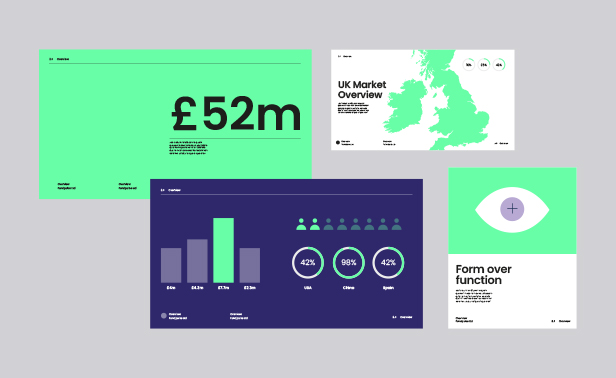
Market data designed in a pitch deck

Keep it on-brand

Maintaining a strong brand identity is an essential aspect of creating a pitch deck that effectively converts. By ensuring your pitch deck aligns with your brand, you can quickly establish trust and familiarity between your brand and the audience. An on-brand pitch deck reinforces the consistency and reliability of your graphics, positively influencing how your business is perceived. When your marketing collateral is cohesive and well-designed, it conveys a sense of organisation and stability, which are highly favourable associations to make.

Why is being on brand so crucial when it comes to your pitch deck?

Let’s explore the key reasons:

Establishing Trust

A pitch deck that reflects your brand identity helps build trust with the audience. When your brand elements, such as colours, fonts, and imagery, are consistent across your pitch deck and other marketing materials, it creates a cohesive and professional impression. This consistency signals that your business is reliable, focused, and pays attention to detail, which can significantly influence the audience’s perception of your credibility and competence.

Creating Familiarity

Consistency in branding helps create a sense of familiarity. When your pitch deck aligns with your existing brand presence, it allows audiences to recognise and recall your business more easily. This familiarity enhances the overall user experience and increases the chances of your key messages and value propositions resonating with the audience.

Reinforcing Brand Values

An on-brand pitch deck reinforces your brand values and messaging. It provides an opportunity to visually communicate your mission, vision, and unique selling propositions. By incorporating brand-specific visuals, language, and tone, you can effectively convey the essence of your brand and make a memorable impression on the viewer.

Enhancing Visual Appeal

Consistency in branding extends to the visual aspect of your pitch deck. A well-designed and visually appealing deck captures attention and creates a positive perception of your business. When your pitch deck is visually aligned with your brand guidelines, it reflects professionalism and attention to aesthetics, which can significantly enhance the overall user experience.


To ensure your pitch deck stays on brand, consider the following tips:

Consistent Visual Elements

Use your brand’s colours, fonts, and logo consistently throughout your pitch deck. This creates a cohesive and recognizable visual identity.

Reflect Brand Tone

Align your pitch deck’s language and tone with your brand’s personality. Whether it’s professional, friendly, or innovative, maintain consistency to reinforce your brand’s voice.

Clear Brand Messaging

Craft your pitch decks content to reflect your brand’s values, mission, and unique selling propositions. Ensure your messaging aligns with your overall brand strategy.

Professional Design

Invest in professional design or use design tools to create visually appealing slides. Pay attention to layout, typography, and the overall aesthetics to create a polished look.

Cohesive Storytelling

Weave your pitch decks narrative in a way that aligns with your brand story. Connect the dots between your brand’s purpose and the problem you’re solving, highlighting the value your business brings to the market.

In conclusion, being on brand is crucial when creating a pitch deck that converts. It establishes trust, creates familiarity, reinforces brand values, enhances visual appeal, and conveys stability. By aligning your pitch deck with your brand identity, you can make a strong and lasting impression, increasing your chances of success for your business.

Summary

Remember, the purpose of a pitch deck is to provide enough information to get the reader’s attention and entice them into a meeting or requesting further information. The goal here is to grab the reader’s attention and leave them craving more. So, resist the urge to overload them with a data dump. Keep your copy relevant and short. Brevity is the key to unlocking the curiosity and enthusiasm of your readers, give then just enough to spark their interest.


About FullSphere

FullSphere is an agency that prides itself on being the experts in presentations and document designs. Working across many brands and businesses, we love designing decks that look beautiful, and above all, meet your business goals. For more information on how our designers can help with your pitch deck, please get in touch.

Image of Author
Adam Yates
5 minute read

4 tips for incorporating payments into your website

Online shopping in the UK is growing. Recent predictions show that the UK’s online spending will increase by 30% by 2024. This is why the payment process is the most essential part of selling products and services online. Online stores must get this right or risk losing customers. In today’s online retail world, two-thirds of online shopping carts are abandoned, and a poor checkout experience is one of the main reasons why. Optimising your checkout page can help customers make their purchases and boost your sales without friction or hassle. Here are a few ways your payment process can be streamlined in your website design:

Finding the right payment service provider

When buying from your business, different customers will want to pay in different ways. Investing in a good payment service provider (PSP) is important, particularly one that can offer your customers various payment options. Some providers even come with physical card machines for in-person shopping, so your customers have more ways to pay. These products not only accept all major credit and debit cards but also allow for transactions online, by phone, via virtual terminals, or through links on email invoices. This way, you can easily customise your payment gateway integration for your clients, with a bonus of fraud screening tools.

On your website, make sure you indicate how customers can pay for their purchases in a clean and detailed way. If you can, add logos to make it easier to catch a customer’s eye, so they don’t spend too long looking for their preferred payment option.

Multiple login options

There’s nothing more frustrating for a customer than finally deciding to purchase something, only to be asked to sign up for an account before checking out. Asking users to log in may be convenient for your marketing strategies, but you might lose some potential customers if you don’t allow them to buy products as a guest.

Make sure the option to log in or go for a guest checkout is clear for users; you can lay out both options on one page or menu before the rest of the following process. Encouraging them to create an account on your website can come after the payment process once you’ve established more trust with them. You can also add some benefits or incentives for purchases with an account for them to consider signing up.

Less is more

Your web design is crucial for ensuring customers close the deal on a sale and build trust in your business. Half of consumers say that a company’s website contributes significantly to their impression of the overall brand. Poor functionality is a major reason why people leave a site; around 42% say that cluttered layouts, lack of visibility, and poor response time makes them exit a page.

For an optimised payment process, give customers a simple yet visually appealing layout on your checkout page. Avoid using multiple fonts, clashing colours or patterns, and huge blocks of text. Keep it clean, but also in line with your business’s brand and visuals. This can will your website look more cohesive and professional, giving customers a sense of trust and familiarity that will make them willing to return for more.

Point out the errors

Customers want a fast and streamlined checkout experience. If they have to fill out all their information again due to typos or missing fields, they might decide it’s not worth their time. If they press the checkout button with incorrect details, highlight where they might have made an error instead of having them redo the process.

Indicating an incorrect cardholder name, email address, invalid card number, and other mistakes can give users more clarity and ease when rectifying their information. It’ll help ensure that they still go through with the transaction as they use your intuitive, easy-to-use payment page.

Image of Author
Adam Yates
10 minute read

HTML email template

Make use of a free HTML email template designed by our experts. Designed with high-resolution images, single and double-column layouts, and full compatibility across all major email platforms. Fully tested and ready to use.

Download the HTML and images or visit Github.

Template preview

View a live preview of the template here.

Inline styling with email templates

Many email platforms lack CSS support. To ensure your HTML email renders correctly, you should always use inline styling. Below is an example of how the styling is inlined in the free template.

Table example: <table align="center" style="text-align: center; vertical-align: top; width: 600px; max-width: 600px; background-color: #ffffff;" width="600"></table>

Column example: <td style="width: 596px; vertical-align: top; padding-left: 30px; padding-right: 30px; padding-top: 30px; padding-bottom: 40px;" width="596"></td>

Heading example: <h1 style="font-size: 20px; line-height: 24px; font-family: 'Helvetica', Arial, sans-serif; font-weight: 600; text-decoration: none; color: #000000;">Heading here</h1>

Paragraph example: <p style="font-size: 15px; line-height: 24px; font-family: 'Helvetica', Arial, sans-serif; font-weight: 400; text-decoration: none; color: #919293;">Paragraph here</p>

Image example: <img style="width: 600px; max-width: 600px; height: 240px; max-height: 240px; text-align: center;" alt="Image" src="https://fullsphere.co.uk/misc/free-template/images/image-3.jpg" align="center" width="600" height="240">

Image sizes

The template’s images are designed at twice their display size to ensure sharp, high-resolution quality on Retina and high-DPI screens.

Tested on all major email clients

The template has been tested and optimised for mobile, desktop and web.

Preview of email tests

Before sending your email, it’s best to test your email configuration and DNS setup using tools like Mail-Tester. This will help ensure your DNS records are correctly set up.

Additionally, we recommend checking for spammy keywords and improving email deliverability with Mailmeteor’s Spam Checker. We’ve started using this tool ourselves to identify and exclude words that could trigger spam filters.

Once your setup is verified, test how your email renders across different clients. You can do this manually or use a tool like Litmus to test against thousands of email clients automatically.

You can learn more about email deliverability by visiting this article.

Custom built HTML templates

If you’re looking for a custom HTML template for your business, FullSphere design and build custom templates inline with your brand and business goals. Get in touch to learn more.

Image of Author
Adam Yates
minute read

Write For Us

FullSphere is providing talented content writers with the chance to submit guest posts for our blog. All articles will be preserved in the blog archives indefinitely. Guest posts are free of charge. An admin fee of £50 +VAT is billable for guest posts which contain a do-follow link.

We only accept on topic articles (design, marketing or development).

Guest post guidelines

Please review the guidelines carefully:

  • All guest posts must be a minimum of 500 words
  • Must contain 2 x links to authoritative websites
  • Links must be placed equally across the post
  • UK English spelling only
  • Articles must not be purely promotional in nature, instead, informative and offer value to the reader
  • Use paragraphs and subheadings
  • The article must be original
  • The article must not be republished on other websites
  • The article will be Copyscape checked before submitting – we don’t allow plagiarism or duplicate content

What can I write about?

We welcome a diverse range of topics which encompass Design and Marketing. While the examples provided below are just a glimpse of what we accept, we are open to considering many more subjects for guest posts:

  • Branding
  • Logo Design
  • Pitch Deck Design
  • Website Design
  • Marketing (digital, email, print, etc)
  • Website Development
  • Search Engine Optimisation (SEO)
  • Technical tips

We do not accept articles on crypto, gambling or adult content.

Feel free to email us to pitch your ideas on topics beforehand.

Article formatting

To help streamline our process and keep all articles consistent, below we have outlined our formatting style.

Summary: A brief summary of the article is required. We use this as a teaser across pages.

Headings & paragraphs: If portions of your text have headings, wrap that text in one of the following codes to help pull that topic out from the rest of the text.

Paragraphs: Paragraphs are to be be 3-5 sentences in length. Articles and blog posts are often skimmed through, so it is good practice to present text in manageable portions as opposed to large and overwhelming chunks.

Bullet points & lists: Where applicable, breaking up text through the use of bullet points and lists helps create visual interest in the article. Please use bullets for unordered lists and numeric for ordered lists such as items with numbered points. (For example, logo design steps to follow). Items on a numbered list that includes sub-points can be bulleted.

Photography: If you are sending images, please make sure that they are not watermarked and of good quality and are ok to be used openly on the web. Although we take great care in making sure images are open source or permission granted, we will not be held responsible if an image is copyrighted or use of has not been granted to the author.

Author section: At the end of your article include your name, title and picture (if you prefer no picture, that’s ok).

Submitting your guest post

Please provide your guest post using a Word Document or Google Doc.

Submit your article to hello [at] fullsphere.co.uk.

Image of Author
Adam Yates
15 minute read

Improve deliverability with Email Marketing

With over 90% of businesses generating sales through Email Marketing, almost 40% of emails sent are flagged as spam. Improving the inbox delivery rate by only a few percent can have the potential of significantly increasing sales and growth.

There are a number of ways to improve the deliverability of emails, from a seamless and sound setup, right through to the email content itself. We’ve listed the best practices, along with useful tools to help improve your campaigns.

DNS configuration (DKIM, SPF & DMARC)

It is crucial that DKIM, SPF and DMARC records are added to your DNS and setup correctly. Without these records, mail platforms won’t be able to tell whether you (the owner of the domain name) sent the email, or whether the email is being spoofed by someone else. Essentially this increases the security of your emails to improve deliverability.

DKIM (Domain Keys Identified Mail)

A DKIM record is a digital authentication key. The setup is taken from your service provider (such as Mailchimp), or from your dedicated IP provider (such as Mailgun). The full DKIM record should be added to the DNS, exactly as instructed. For a reference, the format will look similar to the below:

Name Type Content TTL
email._domainkey.yourdomain.com TXT v=DKIM1; p=76E629F05F70
9EF665853333
EEC3F5ADE69A
2362BECE4065
8267AB2FC3CB
6CBE
6000

SPF (Sender Policy Framework)

An SPF record lists all the IP’s that authorised to send emails. It’s important to include all IP addresses that are being used to send your emails (Email provider, website IP for forms, etc). Here is an example of the setup:

Name Type Content TTL
yourdomain.com TXT v=spf1 mx ip4:139.162.202.227 include:_spf.google.com include:_spf.mailgun.org ~all 3600

In the example above:

IP4: is our dedicated IP address which we’re sending emails from

include: contains the record for our Gmail emails and our Mailgun setup

~all tells receiving mail platforms to accept messages from senders that aren’t in your SPF record, but mark them as suspicious (send to spam)

If you’d like to tighten up your security further, you can use –all.

For a more in-depth understand of configuration on the on SPF records, I’d recommend taking a look at this article created by Google: https://support.google.com/a/answer/10683907.

DMARC (Domain Message Authentication Reporting & Conformance)

A DMARC record essentially ties the DKIM and SPF above together and keeps you in the loop with reports which are emailed to you.

You can use the configuration below, (remember to update the email address):

Name Type Content TTL
_dmarc TXT v=DMARC1; p=none; rua=mailto:[email protected] 6000

Content: v=DMARC1; p=none; rua=mailto:[email protected]

In the example above, you can change p=none; to p=quarantine; or p=reject;

  • p=none; is used to collect feedback and gain visibility into email streams without impacting existing flows. It’s a crucial first step to setting up the configuration.
  • p=quarantine; allows email receivers to treat email that fails the DMARC check as suspicious and files them in a SPAM folder.
  • p=reject; requests that email receivers reject email that fails the DMARC check.

Error checking the config

It is best practice to test your emails after the setup, https://www.mail-tester.com is a great tool which will inform you whether the records have been setup correctly.

Trusted platform/IP address

The IP address used to send the emails can affect the deliverability of your campaigns. A new or blacklisted IP address won’t be trusted by mail platforms.

If you send less than 100,000 emails per month, it is best practice to use a bulk email service provider such as Mailchimp, ActiveCampaign or Sendinblue. These IP address used to send emails will be shared amongst other users sending emails and using their service. These service providers rely heavily on their IP addresses being trusted and not included in blacklists. Some lesser known service providers may not hold the same level of protection against their IP reputation, allowing their customers to spam against the same IP you are sharing. It’s best to go with a well established, trustworthy service provider.

If you’re sending more than 100,000 emails per month and if your data is strong, you could benefit from sending emails with your own dedicated IP address. Any new IP address will need to be ‘warmed up’, which is a practice carried by slowly increasing the send quantity (starting with 100 a day, increasing until you’re sending to 100,000+). Once trust has been built, your IP will likely outperform any other shared IP address in terms of deliverability.

There are a number of providers who you can purchase an IP address off. FullSphere typically use Mailgun because their API works great. A dedicated email marketing software, such as MailWizz, works amazing for scheduling campaigns and managing data

If you have a dedicated IP address setup, you can use this service, to check whether your IP is blacklisted.

Email content

Email content also plays a really big part in deliverability and spam. The content refers to both the subject and body content of the email. There are a number of things we can look at to make improvements:

Personalisation

Sending as a user will always generate a much better response rate than a blanket email, spam filters like it too. You can get very targeted, including first names, and a signature to dress up the email as it would look sending from your own email account.

Avoid spammy words

Avoid using keywords like “Free,” “Investment,” “Offer,” and “Discount,” as these are commonly flagged by spam filters. It’s also best to minimise the use of exclamation marks and capital letters. To further improve email deliverability, we recommend checking for spammy keywords using Mailmeteor’s Spam Checker. We’ve started using this tool ourselves to identify and exclude terms that may trigger spam filters.

Links, images and spelling

Spam filters need to understand your intent. Avoid URL shorteners, check for broken links, and check spelling.

You’ll also want a good text to image ratio. The most common guideline is no more than 40% image coverage and a minimum of 60% text. While exceptions exist, this rule will generally keep you from any deliverability issues.

Attachments

Because viruses and other malicious software can be embedded into documents, spam filters tend to be very aggressive with attachments, whether it be ZIP, DOCX or PDF. You’ll have much better success rate by removing all attachments and instead linking the user to a landing page.

Unsubscribe links

Hiding your unsubscribe link, or making the process difficult, will only result in poor deliverability. You’ll also encourage users to hit the ‘spam’ button, which will effect your future sends.

Make the opt out link very obvious and consider adding ‘list-unsubscribe‘ to your mail headers.

Benchmark for open rates & click rates

If you’re wondering how your campaigns are performing, below is a rough guide for open rates and click rates on B2B, UK data:

Score Open rate Click rate
Very Poor 15% 1%
Average 20% 2%
Good 32% 4.5%
Excellent 40%+ 7%+

For more information regarding Email Marketing and anti-spam techniques, get in touch.

Image of Author
Joe Britch
6 minute read

The difference between Branding and Marketing

A lot of the time businesses rush their Branding and quickly begin Marketing without careful thought or consideration, meaning your idea is not living up to its full potential. However, when both are carried out correctly, your business will have the best possible chance of being a success from the beginning.

Branding

Branding and marketing share similar goals: promoting your message, product, or service to attract new customers. In essence, branding encompasses the look and feel of your business or product, while marketing focuses on how you sell this product.

Crafting an effective brand that resonates with your audience can be challenging. Subtle elements such as colour schemes and font choices can help people relate to what you’re selling. For instance, if you’re marketing bananas, incorporating a black and yellow colour theme can be advantageous. Similarly, employing brand elements that resemble banana bends can strengthen brand recognition. Ultimately, the aim is to capture attention and stimulate curiosity.

To cultivate customer loyalty, your branding strategy should centre around solidifying your credibility both online and offline. When someone peruses your proposal and follows a link to your website, the branding should align and convey a consistent identity. Simple techniques like maintaining consistent font sizes and weights can contribute to building reliability and trust. Consistency in typography subtly reinforces the viewer’s perception of your dependability and expertise. It can mean the difference between a haphazard and confused brand image and one that is concise and structured. Consistent branding also reinforces organisational qualities and signifies that your message, like your typography, is trustworthy. You can explore further on how design can convey trust here.

Marketing

Marketing can appear bewildering and complex, considering the multitude of channels available, including Social Media, Paid Media, Search Engine Optimisation, and Email Marketing. However, by understanding how to leverage each channel effectively, you can propel any business to success.

Your marketing strategy should be tailored to your specific business, as Business-to-Business (B2B) and Business-to-Consumer (B2C) strategies differ significantly. Targeting consumers often proves fruitful through Social Media or Google Ads, whereas B2B companies may find Email Marketing more effective. It’s important to note that while certain strategies may work for one business, they may not yield the same results for yours. Thus, a careful analysis of your business and its operations is crucial in determining the most appropriate marketing approach.

Summary

It is essential to prioritise branding before embarking on marketing efforts. Without a strong brand, marketing initiatives can fall short, preventing you from reaching your full potential. While some poorly branded businesses may achieve success, imagine the level of success they could attain with a well-established brand. Visually appealing elements are naturally more appealing to customers, generating interest and facilitating business expansion. Branding plays a vital role regardless of whether your business is customer-facing; it is crucial to present yourself in the best possible light to enhance your chances of success.

Always begin with branding before delving into marketing. Define, develop, and nurture your brand, and your marketing endeavours will yield optimal results. Regardless of your business’s stage, you should constantly work on defining your company’s identity, shaping audience perceptions, and fostering meaningful relationships with customers. As your business grows, it is imperative to evolve and refine your branding accordingly.